
Starting a fitness journey gives an individual a sense of freedom and power towards building a strong foundation for a healthier and stronger version of themselves. If you are just starting out, it is essential to focus on the foundational components of strength training to ensure effective and safe progress. Strength training not only enhances your muscular capacities, but also also improves bone health, boosts metabolism and contributes to overall well-being. It is important to explore the benefits of establishing a strong foundation and introduce exercises that not only build strength, but also facilitate greater stability and increased range of motion.
A strong foundation provides greater stability and minimizes risk of injury. With a Range-Based Strength training protocol, you proactively target vulnerable movement ranges, simultaneously boosting your strength within those ranges. Just as a house without a solid foundation spells disaster, so too does a short-sighted approach to fitness. While many focus on immediate gains, often at the expense of long-term well-being, it’s vital to maintain a far-reaching perspective. Prioritizing longevity not only fosters short-term progress but also safeguards against potential setbacks in your fitness journey.
Injury prevention or pre-habilitation works to create a solid foundation that emphasizes the correction of imbalances and weaknesses, reducing the risk of injuries as you advance in your training. Many practitioners often fall into the trap of overemphasizing corrective exercises to address imbalances and weaknesses, inadvertently hindering their ability to achieve long-term goals. To strike a healthier balance, it’s essential to shift our focus from isolated exercises, and instead redirect our intention towards enhancing overall performance.
By improving technique and cultivating heightened body awareness, we can instill positive habits, develop the ability to detect early signs of excessive compensation, and push our physical limits. This approach serves to prevent discomfort and potential issues in the long term, while also promoting optimal muscular engagement.When integrated with the progressive overload principle, this strategy ensures a continuous enhancement of strength and flexibility through a progression of a variety of variables such as an increase in resistance, intensity over time and training full range and end range based movements.
The following are by no means the end all be all of exercises that can be used in your training program, but they do provide some solid foundational options to train that will give you a big return on investment.
1. Split Squat Variations
Three variations of Split Squats that can be used are able to target the muscles in the legs in a variety of ways. In each version, the primary focus is to distribute the majority of the weight (70-90%) onto the working leg, typically the front leg, while utilizing the supporting leg (back leg) as a stabilizer and support, accounting for about 10-30% of the load.
- Back leg elevated emphasizes the posterior chain of the working leg.
- Front foot elevated emphasizes the anterior chain of the working leg.
- Both legs elevated incorporate both the front and back of the leg.
It is important to note the positioning of the knee relative to the ankle/foot and the torso positioning relative to the thigh. The more the torso bends over the thigh, the more the posterior chain will be accessed whereas when the torso is more upright then more focused is placed into the front thigh. The further forward the knee travels over the toes, the more the front thigh focuses the exercise and the more the knee maintains a position vertical to the ankle, the more glutes and back side is incorporated. Using these as a frame of reference for what exactly you want to get out of a particular lower body exercise to work the areas of the body that you intend to.
2. Push-Ups and Dips
Push-ups and Dips are excellent for strengthening your chest, shoulders, and triceps. Make modifications as you need to with regards to maintaining full range of motion with good technique and under control. You can modify these exercises by adjusting your body positioning or utilizing support tools to reduce the load while still achieving the full range of motion. Pay attention to hand placement relative to your torso, as this can shift the emphasis of the movement. Also, be mindful of your rib cage positioning to optimize your form. If you find yourself involuntarily making compensatory movements, take it as a signal that the range and/or intensity may be too challenging for your current fitness level.
3. Horizontal Pulling Exercises:
Ring rows or any horizontal pulling movement target your upper back and biceps, which can help to improve posture. Pay close attention to the positioning of your scapula during the exercise. As you contract your back muscles, the scapula should retract, and it’s important to aim for continuous depression of the scapula throughout the movement. As you pull, have the hands in a neutral to underhand grip positioning to maximize the bicep engagement. Concentrate on executing a full range of motion while minimizing compensatory movements for maximum effectiveness.
4. Plank variations and bridge:
Planks offer versatile options to effectively challenge your body and enhance core stability. Begin with the standard plank position, supporting your body on your forearms and toes while maintaining a straight line from your head to your heels. Engage your core muscles as if you were preparing for external resistance.You can diversify your routine by switching positions to target both sides of your body and explore various bridge variations. Adjusting the difficulty level is also an option, allowing you to find the positions that best match your fitness level and goals. Experiment with different plank variations to discover what works best for you.
5. Back Extension and Straight leg deadlifts
Back extensions can be performed with an emphasis on the upper or lower body raising off the ground or bench. Elevating your body more (e.g 45-degree back extension or GHD) allows you to expand the range of motion you train, experiment with different movement patterns, and increase the intensity of the exercise.
Straight leg deadlifts and their variations effectively target the lengthened position of the posterior chain, including the calves, hamstrings, glutes, and lower back. You can perform these exercises with both legs or individually and explore various foot, leg, back, and hip positions to tailor the exercise to your specific needs. Increase the difficulty by increasing the range of motion trained and the intensity at which you train.
6. Core (Full range)
Full range core exercises like GHD sit ups, hanging leg lifts or elevated lying knee tucks can be a great way to train the core through various ranges and intensities. Understand how to use gravity, the weight of your legs through lever adjustments to change the difficulty and movement pattern to fit your needs.
7. Step-Up Variations:
Step-ups target your lower body and depending on the height of the box or elevated surface, you can work on a greater range with relatively minimal need for added weight. Focus on maintaining stability throughout the movement and minimizing compensating with the non working leg. Find a stable surface and step onto the surface with one foot, pushing through your heel. Minimize the use of the non working leg, it should be used primarily as support to stabilize. You can alternate legs for each repetition or stay on one side for all reps before changing.
8. Vertical Pulling exercises:
There are a variety of pulling movements that can be performed to train the upper back and arms. Emphasize using the scapula and upper back to optimize the movement. Adjust the hand positioning (supinated, neutral, pronated) and width to target the primary muscles in a variety of ways. Focus on using full range as much as possible, so an adjustment in the intensity (weight) will be necessary relative to the sets and reps you are trying to achieve.
9. Vertical Pushing exercises
Overhead pressing can be performed in a variety of ways. Minimize the need for stabilizing so that you can train a greater range and perform the movement with more strength. The greater the need to stabilize (Free weights or handstand pushup) the more difficult it will be to go through a big range or use higher levels of weight. Sitting on a bench and using a wall, using a barbell versus dumbbells or even using a smith machine among other machines can be ways to reduce the stability requirement.
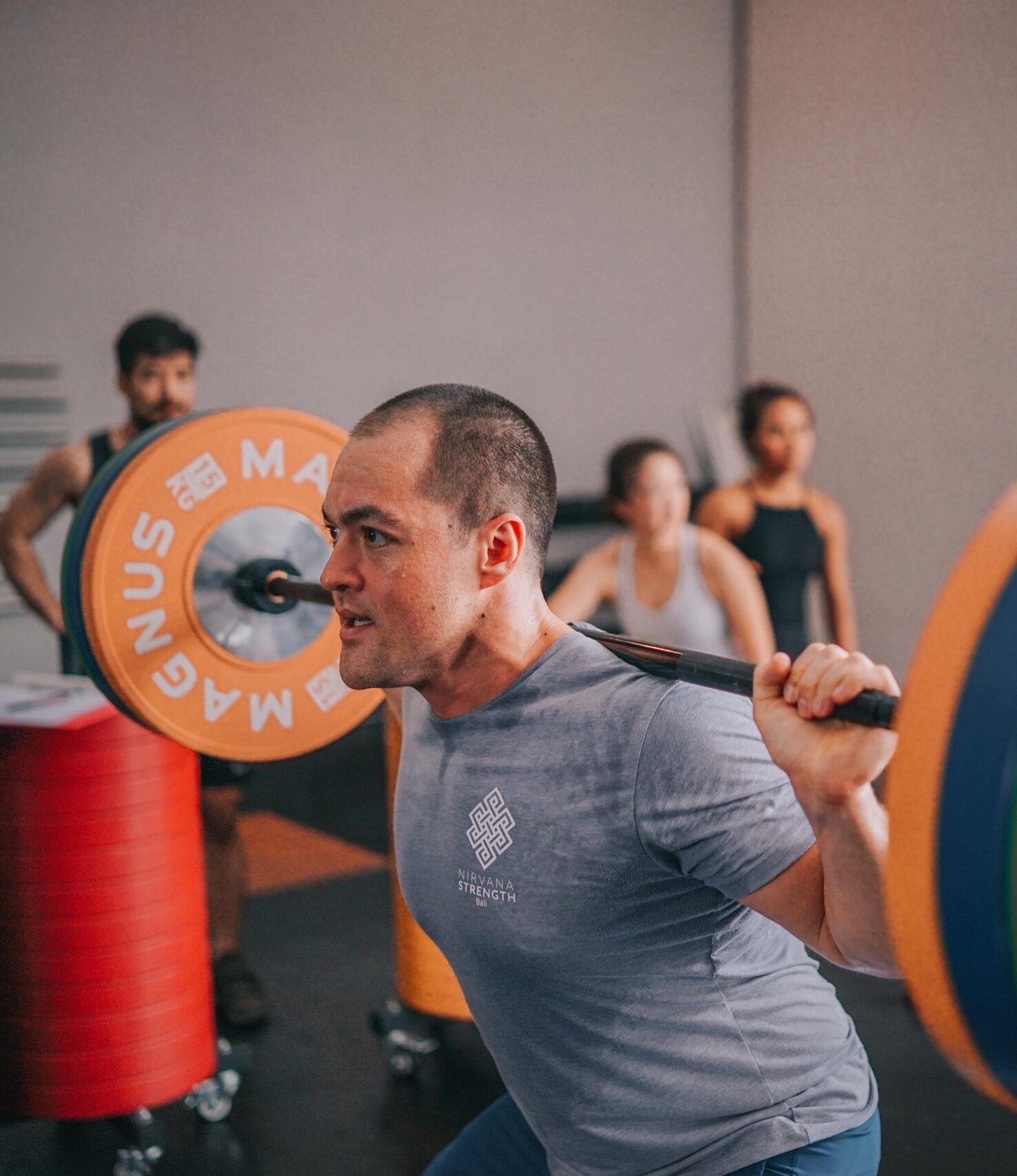
10. Squat variations
Remember the role of the body position relative to the muscles that you want to target from point #1. The high bar versus low bar back squat and the use of front squats are a good example of these adjustments and their emphasis on the muscles worked on the body. Furthermore, you have the option to employ tools such as heel elevation using plates or a slant board, vary leg positioning from a narrow to a wide stance, and adjust the means of increasing intensity by incorporating barbells, dumbbells, or machines. These modifications can effectively shift the emphasis and impact the targeted muscles during your workout.
Focus on good form and stability while working the full range of the movement. As you get stronger, you will be able to progressively increase the difficulty through a variety of means beyond just adding more weight.
Your Journey Begins
To ensure your long-term success and prioritize your overarching fitness goals, it’s a wise investment to develop strength through a combination of full range of motion movements and strength-based end-range exercises, also known as active flexibility training. Remember to prioritize proper form, start with manageable (maintain control) weights, and gradually increase the range and intensity as you become more confident. With consistency and dedication, your foundation will be incredibly stable, driving you towards your fitness goals and beyond.
